
Florida Water Damage Lawyers — When Insurance Doesn’t Cover the Full Extent of Damage
Water damage spreads beyond what’s visible — and insurance estimates often miss it.
24+ years of insurance claim litigation experience
WATER DAMAGE CLAIMS — FLORIDA
Is Your Water Damage Claim Missing the Full Scope of Damage?
Water damage doesn’t stop where it’s visible. It moves behind walls, under flooring, and into structural components — often long before it appears on the surface. Yet many insurance claims are evaluated based only on what can be seen during a brief inspection.
Page reviewed and approved by Carlos D. Cabrera, Esq., Florida-licensed property damage attorney with 24 years of water damage and property insurance claim experience.
26+ Years Experience
$100M+ Recovered
Former Insurance Defense Attorneys
No Win, No Fee
Free Consultation
Water damage is one of the most commonly underestimated types of property loss. Unlike structural damage, it often develops over time and spreads beyond the original point of entry.
Insurance companies frequently rely on surface-level inspections that focus on visible damage while overlooking what’s happening beneath. This leads to estimates that cover minor repairs but exclude deeper structural issues.
Typical Claim Limitations
- Surface-level inspections only
- Limited scope of interior damage
- Minimal moisture detection
- Repair-focused estimates
What Gets Missed
- Moisture inside walls and insulation
- Subfloor and structural damage
- Mold development from trapped moisture
- Long-term deterioration of materials
- Secondary damage from delayed repairs
Florida Water Damage Insurance Claims — Why Coverage Falls Short
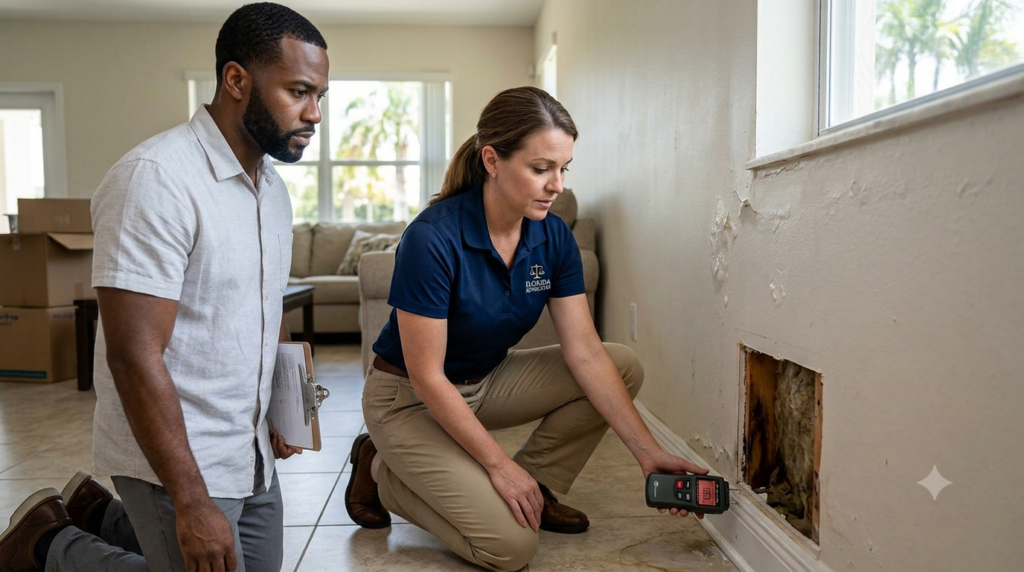
Water damage is one of the most common property insurance claims in Florida — and one of the most commonly underpaid. Unlike structural damage from a storm or fire, water damage is progressive and often hidden. It travels behind walls, under flooring, into structural framing, and through building systems in ways that are not visible during a standard insurance inspection. Estimates based on surface observations consistently miss what is happening inside the building envelope.
Florida Advocates was founded by attorneys who spent years on the insurance defense side evaluating exactly these claims. We know how adjusters are trained to assess water damage and where those assessments systematically leave money on the table. We engage independent moisture specialists and structural engineers who document what is actually inside the walls — not just what is visible on the surface.
Insurance companies benefit from this invisibility. An adjuster who inspects a property within days of a water event sees standing water removed, visible staining, and surface damage. What the inspector does not see — and what the estimate does not include — is the moisture that has already penetrated structural materials, the conditions that will produce mold within 48 hours, and the secondary damage that will materialize over the following weeks. By the time that damage becomes visible, the claim has often already been settled.
Florida Water Damage Insurance Law — What You Need to Know

The Sudden and Accidental Requirement

Standard Florida homeowner policies cover water damage that is sudden and accidental — a burst pipe, an appliance failure, a roof leak caused by a storm event. They do not cover water damage that results from gradual deterioration, long-term seepage, or maintenance failures. This distinction — sudden versus gradual — is one of the most commonly disputed issues in water damage claims.
Insurers frequently argue that water damage was gradual and therefore excluded, even when the damage was first discovered suddenly. The key is establishing the actual origin and timeline of the water intrusion. An independent plumber or moisture specialist who can document when the leak began — based on the physical condition of affected materials, mold growth patterns, and the degree of material degradation — directly addresses the gradual damage argument.
Florida Statute 627.70131 — Claim Handling Obligations

Your insurer must acknowledge your water damage claim within 14 days, investigate promptly, and pay or deny within 90 days of receiving proof of loss. Delays in water damage claims are particularly damaging because the damage continues to worsen — mold grows, structural materials degrade further, and the cost of remediation increases — while the insurer’s investigation drags on. We document every deadline and pursue bad faith remedies when insurers delay unreasonably.
⮎ Learn more about Florida Statute 627.70131
HB 837 (2023) — Claim Filing Deadlines

Under Florida’s current property insurance laws, you have 1 year from the date of loss to file a new property insurance claim and 18 months to file a supplemental claim on an existing open claim. These deadlines are strictly enforced. If you have experienced water damage and have not yet filed a claim, or if you filed and received an inadequate settlement, contact us immediately.
Types of Water Damage Claims We Handle
Burst pipe and plumbing failure damage
Roof leak and storm-related water intrusion
Appliance failure — dishwasher, washing machine, refrigerator water line
HVAC condensate overflow and drain line failure
Flood damage coverage disputes — wind vs water classification
Mold resulting from covered water damage events
HOA and COA water damage from common areas
Negligent contractor water damage
Water damage claim denials and underpayments
Bad faith insurance handling of water damage claims
How Water Damage Claims Are Systematically Undervalued
-
Hidden Moisture Inspections
Surface-only inspections that miss moisture inside walls, flooring, and structural members
-
Low Repair Estimates
Estimates based on preferred contractor rates rather than actual market costs
-
Sudden vs. Gradual Damage Disputes
Gradual damage arguments applied to claims that were clearly sudden events
-
Improper Mold Exclusions
Mold excluded as a secondary condition rather than covered as damage resulting from the covered event
-
Drying & Remediation Costs
Structural drying and remediation costs excluded from estimates
-
Ignored Building Code Upgrades
Code upgrade requirements ignored in repair estimates
-
Delayed Damage Exclusions
Secondary damage from delayed drying excluded as unrelated to the original event
What to Do After Water Damage — And What NOT to Do
Do:
- Document all visible damage immediately with photographs and video before any cleanup begins.
- Begin emergency mitigation to prevent the damage from worsening — but document the pre-mitigation condition first.
- If possible, preserve samples of damaged materials before removal. File your insurance claim promptly.
Do NOT:
- Do NOT give a recorded statement to your insurer’s adjuster without legal advice.
- Do NOT authorize repairs before the full scope of damage has been independently assessed.
- Do NOT sign any release or accept any settlement without legal review.
- Do NOT assume the insurer’s initial estimate reflects the true cost of full restoration.
Water Damage Claims We Handle
Pipe Burst
Sudden pipe failures can release large volumes of water into walls, ceilings, and flooring within minutes.
Flood Damage
Water entering from rising ground levels or external sources can cause widespread damage.
Mold Damage
Mold can develop quickly after water intrusion, especially in humid Florida conditions.
Plumbing Leak
Ongoing or hidden leaks from plumbing systems can lead to gradual damage behind walls and under floors.
Why Clients Choose Florida Advocates for Water Damage Claims
Water damage claims require more than basic inspection — they require understanding how moisture spreads and how damage develops over time.
Florida Advocates brings experience from both sides of the insurance process. Having worked in insurance defense, the firm understands how claims are evaluated and where they are often reduced.
Each claim is approached with detailed documentation and a strategy focused on uncovering the full extent of damage — not just what appears on the surface.
Your Home Comes First
We focus on restoring your home — not just resolving paperwork
No Win, No Fee
You pay nothing unless we recover money for you. No upfront costs, no hourly fees, no financial risk to your family.
Free Consultation
Speak directly with a Florida property damage attorney at no cost. We'll review your claim and tell you exactly where you stand.
100,000+ Cases Handled
Our attorneys have handled over 100,000 insurance claims across Florida, including cases argued before the Florida Supreme Court.
Your Water Damage Claim Is Handled by an Experienced Florida Property Attorney

CARLOS D. CABRERA, ESQ.
Lead Property Damage Attorney
24 Years Experience | Former Insurance Defense Counsel | Million Dollar Advocates Forum | Florida Legal Elite | Bilingual (English/Spanish)
Carlos D. Cabrera is Florida Advocates’ lead property damage attorney, bringing 24 years of experience and a rare perspective — he spent years defending insurance companies before switching to represent the policyholders they denied. He has recovered millions of dollars for Florida homeowners, condo owners, and businesses whose insurance claims were denied, delayed, or underpaid. Carlos is a member of the prestigious Million Dollar Advocates Forum, has been recognized by Florida Legal Elite, and is fully bilingual in English and Spanish, allowing him to serve Florida’s diverse communities.
Notable Results:
- $3,000,000 — Condo fire damage recovery
- $1,000,000 — Waterfront restaurant hurricane claim
- $750,000 — Restaurant fire (neighboring property fault)
We Handle Everything
From Water Damage to Full Recovery — How the Process Works

Strategy Consultation
We evaluate your claim, identify gaps, and build a clear path to recovery from day one.
Every successful claim starts with a clear strategy. During your free consultation, we review your insurance policy, assess the damage, and identify any gaps or issues in your claim. Whether your case is just starting or already denied, we break down your options and explain exactly how to move forward.
We don’t give vague advice. You’ll get a straightforward evaluation of your claim’s strength, potential value, and the best approach to maximize your recovery. From day one, our goal is to put you in a stronger position against the insurance company.

Gather Evidence
We collect and document every detail to ensure your claim is fully supported and hard to dispute.
We build your claim on facts, not assumptions. Our team collects and organizes all critical evidence, including photos, inspection reports, repair estimates, and policy details. If needed, we work with independent experts to fully document the extent of your property damage.
Insurance companies often rely on incomplete or biased inspections to reduce payouts. We make sure nothing is overlooked—every detail is accounted for and properly supported to strengthen your claim from the ground up.

Send a Demand Letter
We present a clear, evidence-backed demand that pushes the insurance company to respond fairly.
Once your claim is fully documented, we prepare and send a formal demand letter to the insurance company outlining the full extent of your damages and the compensation you are owed under your policy. This isn’t a basic request—it’s a detailed, evidence-backed position that puts pressure on the insurer to respond seriously.
Our demand clearly defines the value of your claim, supported by documentation, expert findings, and policy terms. At this stage, we shift the dynamic—making it clear that your claim is being handled professionally and will not be undervalued or ignored.

File a PropertyDamage Lawsuit
When insurers won’t act fairly, we take legal action to enforce your rights.
If the insurance company refuses to offer a fair settlement, we take the next step—filing a lawsuit to protect your rights and pursue the compensation you’re owed. At this stage, your claim becomes a legal case, and the insurer is required to formally respond.
Filing a lawsuit shows the insurance company you’re serious. It often shifts the balance, forcing them to reevaluate your claim more carefully. We handle the entire legal process, from filing to court representation, while continuing to push for a favorable resolution.

Discovery
We uncover key evidence and hold the insurance company accountable.
During discovery, both sides are required to exchange information and evidence related to the claim. We gather documents from the insurance company, review their internal assessments, and identify any inconsistencies, delays, or unfair practices that may strengthen your case.
This stage is where the pressure builds. By uncovering how the insurer handled your claim, we position your case for stronger negotiations or trial if needed. Our goal is to expose gaps in their process and reinforce the true value of your damages.

Mediation
We negotiate from a position of strength to secure a fair settlement.

Property Damage Trial
We present your case in court to pursue the full compensation you deserve.

Disbursement of Compensation
We finalize your case and ensure your compensation is delivered without delays.
Once your case is successfully resolved—through settlement or trial—the final step is securing and releasing your compensation. We ensure all funds are processed correctly, liens (if any) are handled, and you receive your payout as quickly as possible.
Our team walks you through the final breakdown so everything is clear and transparent. No confusion, no surprises—just the results you fought for, delivered.
SETTLEMENT RESULTS
Real Results for Florida Water Damage Clients
- Insurance companies make their first offer based on their adjuster's assessment — not yours. Here is what happens when those offers are properly challenged.

Condo water damage. Insurer offered $17,000. Full scope proved and settled for $258,600.
Condo pool overflow causing water damage to units below. COA found negligent. Full settlement.
Condo flooded during roof replacement. COA held responsible. Full settlement.
- Attorney Advertising. Prior results do not guarantee a similar outcome.
Water Damage Insurance Questions — Answered by Florida Attorneys

Carlos D. Cabrera, ESQ.
Florida Advocates,
Is water damage covered by my Florida homeowner insurance?
Standard Florida homeowner policies cover sudden and accidental water damage from covered internal sources — burst pipes, appliance failures, and storm-related roof leaks that allow rain to enter. They do not cover flooding from rising external water — that requires a separate flood insurance policy through the National Flood Insurance Program (NFIP) or a private carrier. The distinction between covered internal water damage and excluded external flooding is one of the most frequently disputed issues in Florida water damage claims.
My insurer says the water damage was gradual and excluded. How do I challenge that?
The gradual damage exclusion is one of the most commonly applied — and most frequently misapplied — exclusions in water damage claims. An independent plumber or moisture specialist can assess the physical condition of affected materials and provide an expert opinion on when the water intrusion began and how long it had been developing before discovery. Mold growth patterns, material degradation levels, and pipe condition are all evidence of timing. We use this independent expert documentation to directly rebut gradual damage characterizations.
How long do I have to file a water damage claim in Florida?
Under Florida’s current property insurance laws (HB 837, 2023), you generally have 1 year from the date of loss to file a new property insurance claim and 18 months to file a supplemental claim on an existing open claim. These deadlines are strictly enforced and represent a significant reduction from prior law. If you discovered water damage recently or believe your prior settlement was insufficient, contact us immediately.
The insurance company's estimate does not cover all the repairs. What can I do?
An insurer’s initial estimate is not the final determination of your claim’s value. If the estimate does not cover the full cost of restoration — including hidden damage, structural drying, mold remediation, and code compliance costs — you can submit a supplemental claim supported by independent contractor estimates and engineering reports. We compile this documentation and formally challenge insufficient estimates. Most water damage claims that receive legal representation see significantly higher recoveries than the initial insurer estimate.
My water damage claim was denied. What are my options?
A denial is not final. Depending on the reason, your options include filing a supplemental claim with additional documentation, invoking the policy’s appraisal process to dispute valuation, filing a Civil Remedy Notice under Florida Statute 624.155, and filing a lawsuit. The right approach depends on the specific denial reason and your policy’s terms. Contact us for a free review before accepting any denial as final.
What does it cost to hire Florida Advocates for a water damage claim?
Nothing unless we recover for you. Free consultation, no upfront fees, no attorney fees unless we win. Under Florida law, if we prevail in litigation, the court may order the insurer to pay your attorney’s fees.
No Fee Unless We Win

We work on a contingency fee basis:
- Free consultation — no cost to speak with us
- No upfront fees — we advance all case costs
- No attorney fees unless we recover for you
- You will never receive a bill from us while your case is active
Florida Advocates Office Locations
Dania Beach (Headquarters)
45 E Sheridan Street, Dania Beach, FL 33004
North Miami
13499 Biscayne Blvd #107, North Miami, FL 33181
Tampa
238 E Davis Blvd #210, Tampa, FL 33606
Phone: 754-263-4252
Hours: Monday – Friday 9:00 AM – 5:00 PM
Available by phone 24/7 for emergencies
Water Damage Lawyers by Location
We represent water damage clients throughout Florida.
Broward County
- Fort Lauderdale
- Dania Beach
- Hollywood
- Broward County
Miami-Dade County
- Miami
- North Miami
- Miami Beach
- Hialeah
Palm Beach County
- West Palm Beach
- Boca Raton
- Palm Beach County
Tampa Bay Area
- Tampa
- St. Petersburg
- Hillsborough County
Northeast Florida
- Jacksonville
- Duval County
Treasure Coast
- Port St. Lucie
- Fort Pierce
- Martin County
Orlando / Central Florida
- Orlando
- Orange County
- Seminole County
Southwest Florida
- Fort Myers
- Naples
- Cape Coral
- Lee County